The Symbolism and Technique of Jan van Eyck’s Arnolfini Portrait
The Arnolfini Portrait, painted by Jan van Eyck in 1434, stands as one of the most celebrated works of the Northern Renaissance. This small but remarkably detailed oil panel depicts a wealthy merchant, likely Giovanni di Nicolao Arnolfini, and his wife in a Flemish interior. The painting is renowned for its meticulous rendering of textures, from the fur trim of the man’s robe to the wooden floorboards and the convex mirror in the background. However, beyond its surface realism, the work is layered with symbolic objects and compositional choices that invite multiple interpretations. By examining Van Eyck’s innovative oil glazing technique and the hidden meanings embedded in the scene, viewers can better understand how this masterpiece functions as both a document of its time and a sophisticated visual statement.
Van Eyck’s approach to oil painting represented a significant departure from the tempera-based methods common in earlier European art. He refined the use of oil as a medium, allowing for greater translucency, depth of color, and precision in detail. The Arnolfini Portrait exemplifies these advances through its luminous surfaces and the careful modulation of light across various materials. At the same time, the painting’s composition integrates a complex network of symbols—the dog, the fruit, the mirror, the chandelier—each contributing to a narrative that has been debated for centuries. The following sections explore these technical and symbolic dimensions, offering a contextual analysis of how Van Eyck combined craft with meaning.
This article does not attempt to provide a definitive interpretation of the painting, as the ambiguity of its details has long been part of its scholarly interest. Instead, it focuses on the methods and possible readings that have emerged from art historical research. Understanding the tools and symbols that Van Eyck employed can shed light on the broader artistic and cultural currents of the 15th century, while also illustrating why this work continues to fascinate audiences today.
Oil Glazing Technique and the Creation of Luminosity
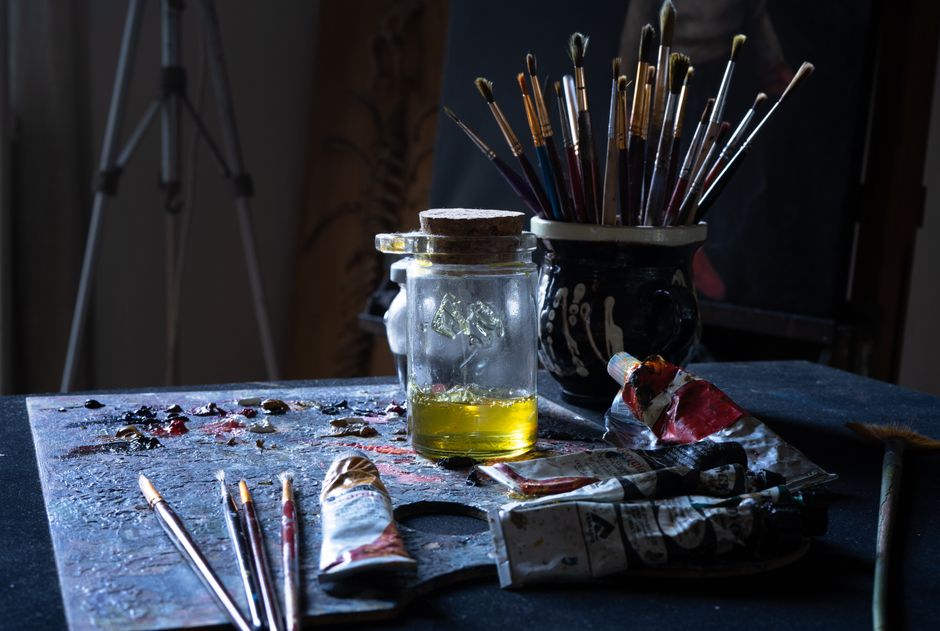
Jan van Eyck is often credited with perfecting the oil glazing technique that allowed him to achieve unprecedented levels of realism. Unlike egg tempera, which dries quickly and leaves a matte finish, oil paint dries slowly and can be applied in thin, transparent layers known as glazes. Van Eyck built up his compositions by alternating layers of opaque underpainting with translucent washes of color. This method enabled him to control the way light passed through the paint and reflected off the white ground beneath, creating a subtle glow that simulates natural illumination.
In the Arnolfini Portrait, the application of glazes is particularly evident in the rendering of the bride’s green dress. The fabric appears to shimmer with depth because Van Eyck layered a dark green pigment over a lighter base, then added highlights and shadows in successive thin coats. The same technique is used for the polished brass chandelier, where multiple transparent layers create reflections that mimic the play of candlelight. Each surface in the painting—whether the fur, the wood, or the mirror—demonstrates a methodical process of building up color and value through many thin applications.
Art conservators have noted that Van Eyck also used a technique called “wet-on-wet” for certain details, blending colors while the paint was still fresh to achieve soft transitions. The faces of the two figures, for instance, show a gradual blending of tones that gives them a lifelike warmth. This methodological approach to oil painting required patience and precision, as each layer had to dry before the next could be applied. The result is a surface that appears almost photographic in its clarity, yet retains a distinct painterly quality that highlights the hand of the artist.
Symbolic Objects and Their Possible Meanings
The interior of the Arnolfini Portrait is filled with objects that carry symbolic weight. Art historians have long debated whether these elements serve purely as status symbols, religious allegories, or references to the specific circumstances of the couple. The convex mirror at the center of the composition is among the most scrutinized features. It reflects two figures who appear to be entering the room, one of whom may be Jan van Eyck himself, as well as the backs of the main couple. The mirror is surrounded by ten small medallions depicting scenes from the Passion of Christ, suggesting a connection between the domestic sphere and the sacred.
The single candle burning in the chandelier has been interpreted as a symbol of the presence of God or the union of marriage. Similarly, the little dog at the feet of the couple may represent fidelity, while the discarded shoes and wooden clogs could signify that the room is a holy space. The oranges on the windowsill and chest have been linked to wealth (as exotic imports) but also to purity and the Golden Age, given their color and form. The bed in the background, typical of Flemish interiors, is often associated with the domestic and marital roles of the couple.
It is important to note that these interpretations are tentative and often depend on the cultural conventions of the time. For example, the gesture of the man raising his right hand has been read as a vow or a blessing, while the woman’s hand placed on her belly may indicate a desire for fertility, not necessarily a pregnancy. The painting itself does not provide a clear narrative, and the absence of a definitive wedding document leaves room for speculation. The symbolic objects function as layers of meaning that enrich the viewing experience without locking the painting into a single explanation.
Innovative Use of Light and Reflection
Light plays a central role in the Arnolfini Portrait, not only as a technical tool but also as a vehicle for symbolism. Van Eyck captured the quality of natural light entering from an unseen window on the left, casting soft shadows across the room and illuminating the figures in a way that emphasizes their three-dimensionality. The light falls unevenly, highlighting the contours of the man’s face and the folds of the woman’s dress, while leaving the background in partial shadow. This careful distribution of light creates a sense of depth that was revolutionary for its time.
The convex mirror is the most striking example of Van Eyck’s mastery of reflection. Unlike flat mirrors, a convex surface distorts and compresses the image, yet Van Eyck rendered the reflected scene with remarkable accuracy, including the figures of two men and the window from which light enters. The mirror also reflects the ceiling beams and the chandelier, creating a secondary viewpoint that expands the spatial awareness of the viewer. This technique of including a reflection within the painting was highly innovative and demonstrated a sophisticated understanding of optics.
Beyond the mirror, reflections appear on the brass chandelier and the metal fittings of the furniture. Van Eyck painted highlights and specular reflections with small, precise brushstrokes that convey the smoothness of polished surfaces. The candle flame, though small, is painted with a luminous core and a soft glow that suggests the flickering of real light. This attention to the behavior of light across different materials—from the sheen of silk to the matte texture of the wooden floor—gives the painting a unified visual coherence. Each reflective element invites the viewer to consider the relationship between the real and the painted, the visible and the symbolic.
Composition and Spatial Construction
The composition of the Arnolfini Portrait is carefully arranged to balance the figures and the surrounding objects while creating a sense of intimate domestic space. Van Eyck placed the couple close to the picture plane, with only a small amount of space between them and the viewer, which creates a feeling of proximity. The man stands on the left, his body turned slightly inward, while the woman faces him directly, her hand meeting his. The space between them is occupied by the dog and the folds of her dress, visually connecting the two figures without merging them.
The perspective in the painting is not strictly linear in the Italian Renaissance sense; instead, Van Eyck used an empirical method that relied on observation and subtle adjustments. The floorboards recede toward a vanishing point near the mirror, and the lines of the bed, the window, and the ceiling beams all converge roughly in that area. This approach gives the room a convincing depth while allowing the artist to emphasize certain details. The mirror, positioned at the vanishing point, acts as a focal hub that draws the eye and reinforces the central theme of reflection and witness.
Van Eyck also used the composition to highlight the social status of the subjects. The profusion of expensive objects—the oranges, the ornate chandelier, the elaborate clothing—serves as a visual inventory of wealth. Yet the spatial arrangement avoids clutter by grouping objects along the edges of the room, leaving the central area open for the couple. This balance between detail and negative space is one of the painting’s strengths, allowing the viewer to explore the scene methodically without feeling overwhelmed. The composition thus functions on two levels: as a realistic depiction of a specific room and as a carefully orchestrated display of meaning.
Historical Context and Scholarly Interpretations
The Arnolfini Portrait has generated extensive scholarly debate regarding its purpose and meaning. For many years, it was assumed to depict a wedding ceremony, supported by the presence of the single candle, the dog, and the depiction of the man’s raised hand as a vow. However, more recent research suggests that the painting may instead represent a betrothal or a legal contract. The Latin inscription on the wall, “Johannes de Eyck fuit hic 1434” (Jan van Eyck was here 1434), and the reflection of two witnesses in the mirror indicate that the painting itself may have served as a documentary record, much like a marriage certificate or a legal testament.
The identity of the woman remains uncertain. While she is often identified as Costanza Trenta, the first wife of Arnolfini, she may also be his second wife, Giovanna Cenami, depending on the date of their marriage. The lack of definitive records means that any identification remains speculative. Similarly, the status of the couple—whether they were already married, betrothed, or commemorating a different event—continues to be argued in art historical circles.
Whatever the specific occasion, the painting reflects the values of the Burgundian court and the mercantile culture of Bruges. It displays wealth, piety, and attention to detail that were prized in the 15th century. Van Eyck’s role as a court painter to Philip the Good gave him access to pigments, patrons, and a context that valued both technical skill and symbolic depth. The Arnolfini Portrait thus stands as a product of its time, but its layered meanings and exquisite execution ensure its relevance across centuries. Ultimately, the painting invites continued exploration, allowing each generation to find new insights in its delicate brushwork and quiet symbolism.